









This therapist directory is offered in partnership with BetterHelp. If you sign up for therapy after clicking through from this site, HelpGuide will earn a commission. This helps us continue our nonprofit mission and continue to be there as a free mental health resource for everyone.
Need to talk to someone now? Find a crisis helpline
If you're a BetterHelp therapist with questions about your directory listing, please contact therapists@betterhelp.com
Looking for the best online therapy services? HelpGuide’s staff surveyed real users and personally tested and reviewed the top platforms to rate them on therapist quality, affordability, privacy and security, user experience, and effectiveness.

Looking for the best online therapy services? HelpGuide’s staff surveyed real users and personally tested and reviewed the top platforms to rate them on therapist quality, affordability, privacy and security, user experience, and effectiveness.

We independently test and review all of the services we recommend. When you sign up through our links, we may earn a commission, which helps support our nonprofit mission.
Online therapy makes it easy to seek mental health care from the comfort of your own home. But with more and more companies providing therapy online, it can be difficult to know which ones to trust. To help you find the service that’s right for you, HelpGuide’s editorial team researched 87 online therapy platforms, surveyed over 1,300 online therapy users, and then narrowed down our results to 13 platforms, which we personally tested. Here’s what we recommend.
For over 25 years, HelpGuide has been a trusted nonprofit helping millions of people each year improve their mental health and wellness. Our mission has always been to empower people with well-researched, accurate information that they can use to strengthen their mental health and well-being—and we bring those same values and principles to our online therapy reviews.
HelpGuide’s editors, writers, and support staff spent 300+ hours conducting user surveys, researching and analyzing 87 online therapy services, and then personally testing platforms for at least one month each.
Our analysis began by researching 87 reputable online therapy platforms (as well as numerous directories). Among other factors, our team analyzed pricing models, cancellation policies, platform certifications, and privacy and security measures to help identify which services offer the best value and safest user experience.
We also examined each platform to establish factors such as how widely available it was across the United States, the different types of therapy offered (teen therapy, couples counseling, substance use disorder therapy, for example), and the inclusivity of care offered (are there therapists catering to people with ADHD or autism, for example, or from the LGBTQ+ community?). We weighted each feature, totaled up the scores, and then hand-tested the highest rated.
Since HelpGuide staff members are based in just three different U.S. states, we wanted to broaden our net to gauge the opinions of users from all across the country. So, in addition to our hands-on testing, we also collected extensive surveys from over 1,300 real online therapy users to measure factors such as satisfaction, therapist responsiveness, value for money, and platform usability.
We asked users everything from the type of technical problems they encountered to how their experiences on specific platforms compared to in-person therapy, whether they’d recommend a service to others, and how much a platform had helped them make progress towards their personal goals. All this large-scale, detailed user feedback played an important part of our online therapy scoring methodology and helped us ensure that our recommendations are suitable for a broad and diverse group of users.
To validate our testing methodology, we consulted with licensed therapists, psychologists, and psychiatrists, including members of our Professional Advisory Council. These mental health professionals reviewed our evaluation criteria and helped us refine how we scored platforms for therapist quality, care structure, and ethical standards. Their input ensured our rankings reflect what truly matters in a therapeutic setting, like emotional safety, professional integrity, and clinical effectiveness.
To validate our testing methodology, we consulted with licensed therapists, psychologists, and psychiatrists, including members of our Professional Advisory Council. These mental health professionals reviewed our evaluation criteria and helped us refine how we scored platforms for therapist quality, care structure, and ethical standards. Their input ensured our rankings reflect what truly matters in a therapeutic setting, like emotional safety, professional integrity, and clinical effectiveness.
There’s no substitute for hands-on testing to really understand the benefits and drawbacks of an online therapy service. After narrowing down all the platforms we researched to 13 options that met our scoring qualifications, HelpGuide staff members used each platform for a minimum of four weeks as regular users, without disclosing who we worked for or what our aims were. We simply wanted to experience each platform as any other users would.
We went through the intake and matching process and booked and attended regular therapy sessions, assessing the platform functionality, crisis protocols, and therapist quality. We messaged our therapists between sessions, contacted customer support to gauge their helpfulness and response times, and took every step necessary to protect the privacy of our health information. If a platform offered extra features, such as worksheets, journals, or meditations, we tested them all.
Since finding the right therapist can often involve some shopping around, we also went through the process of switching providers, something that many people find is much easier online than in-person. Finally, we closed our accounts, noting any billing and refund issues.
During our testing, we each kept a weekly journal recording our experiences and completed detailed questionnaires so we could accurately compare and contrast the different platforms. At the end of testing, we matched notes and shared experiences to help inform our choices for the best online therapy platforms.


Therapist quality and matching accuracy

Pricing and value for money

Session types and communication options

Ease of use and platform navigation

Insurance coverage and payment options

Privacy and security

Customer service experience
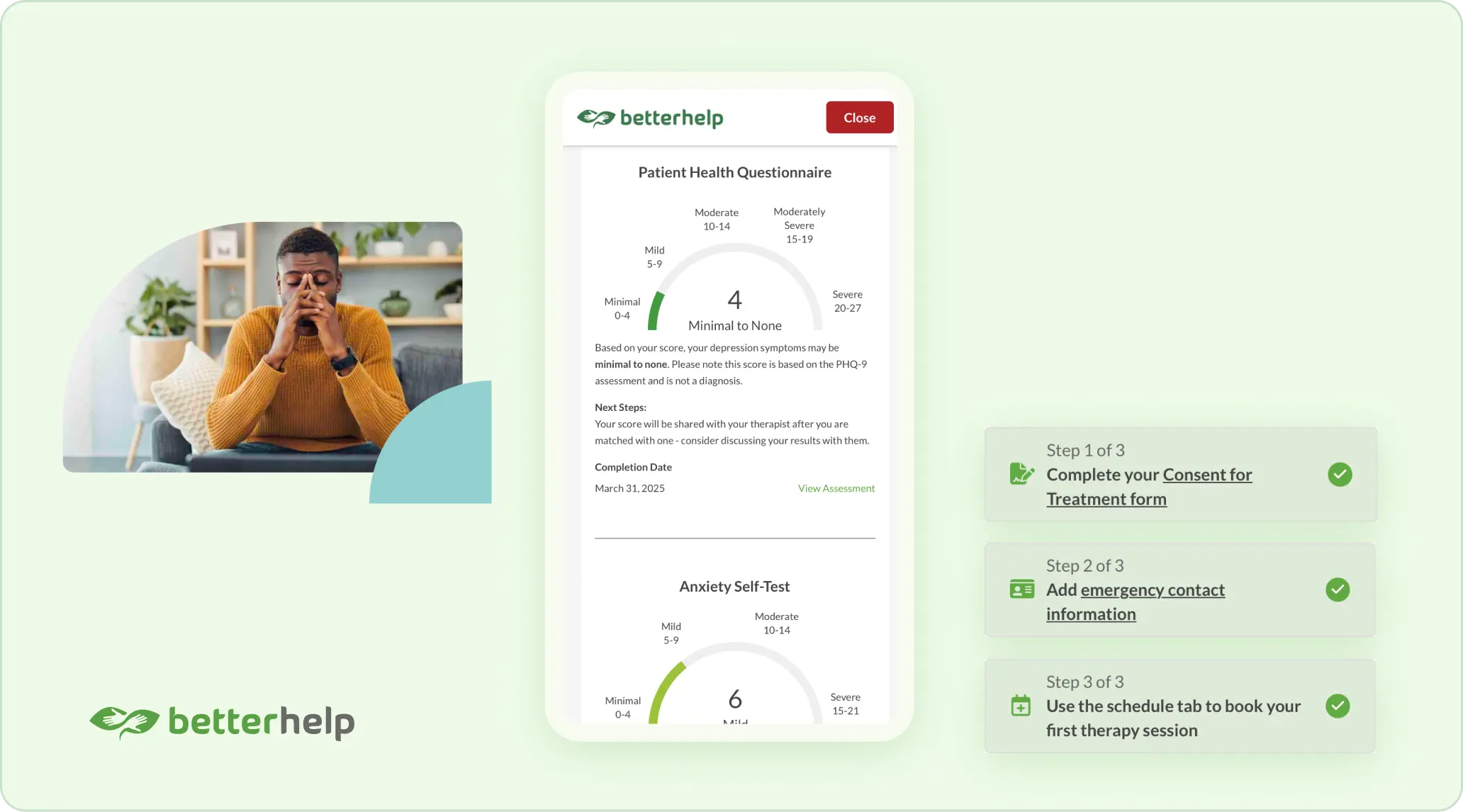
| BetterHelp is most suitable for: | People looking for a broad selection of therapists without using insurance |
| Starting price: | $65-$100 per week (billed monthly) |
| Insurance accepted? | No |
| Financial aid: | Available (25% of users) |
| Therapy types: | Individual, couples, teens |
| Session formats: | Video, audio, text messaging |
| Time to first session with therapist: | 1-2 days |
| Psychiatry services: | No |
We surveyed 100 BetterHelp users across the United States and had two of our in-house staff test BetterHelp. In our survey results we found that the biggest strength was accessibility. Regardless of location, users were able to schedule timely sessions, including during evenings and weekends.
“I was more aware of my emotions, could cope better with things that were stressing me, and I became more confident.”
Survey respondent
“My therapist helped me get through serious anxiety. I wish I could’ve continued, but it became too expensive.”
Survey respondent
Overall satisfaction:
Value for cost:
Empathy rating:
Privacy and security rating:
Platform navigation rating:
“Prior to this, I was skeptical that I’d be a good fit for telehealth therapy. Now I feel much more comfortable with it.”
Sheldon Reid, Staff Writer
“I wish I wasn’t auto-matched with a therapist at the start. I would’ve preferred and expected at least two options. More options appeared when I decided to switch therapists.”
Sheldon Reid, Staff Writer
BetterHelp’s sign-up takes 10 to 20 minutes for most people (77 percent), but nearly 40 percent wanted more transparency on therapist qualifications and pricing upfront. Here’s what happens:

Complete a questionnaire about your mental health needs and preferences.

Get matched (typically within 1–2 days).

Choose communication format: video, phone, or messaging.

Start your first session, often within 3 days of sign-up.

Tested by: Sheldon Reid, Staff Writer
Tested by: Chris Saranchock, Director of Operations & Multimedia
BetterHelp is one of the largest online therapy platforms, with more than 30,000 licensed therapists in its network. It covers all 50 states in the U.S. and is also available in many countries internationally, including the UK, Canada, Australia, and India.
One of our team members tested BetterHelp in May 2025 for the purposes of this review. Another staff member tested it in 2023. On both occasions, our staff appreciated not only the wide selection and quality of therapists, but also the level of diversity, the thoroughness of the intake questionnaire, the extra features offered on the platform, and the ease of switching between providers.
The size of BetterHelp’s network meant that our testers were offered lots of choices when making their therapist matching preferences. As well as being able to select a provider by age and gender, they were able to choose from therapist specialties such as depression, anxiety, addictions, ADHD, anger management, sleeping disorders, grief and loss, and relationship or career issues. They were also able to choose a therapist who shared their racial, cultural, or religious background, with options such as Christian-based, non-religious, therapist of color, or LGBTQ+ therapist. Having recorded all of his preferences, our most recent tester was matched the following day and offered a good selection of dates and times for his first session.
Our testing revealed both benefits and drawbacks to initially being matched with a therapist on BetterHelp. If you’re experienced with online therapy and have a clear idea of the qualities you’re looking for in a therapist, it may be frustrating not to be able to choose a provider from a list of potential matches. However, for those new to therapy or unsure what they should be looking for, being matched can be a useful way to get started quickly and easily. If your first therapist isn’t a good match, switching is a very simple process. On making a change, our tester was presented with a list of 10 therapists to choose from.
Our May 2025 survey respondents were also able to find a good match quickly. 59 percent of the BetterHelp users we surveyed found the right therapist with their first match, 91 percent by the second.
Once matched, our staff members appreciated the quality of therapy they were provided on BetterHelp, although not every delivery method works well. BetterHelp offers online therapy via live video, phone, and messaging. Our most recent tester tried the latter to start, expecting it to be like texting a friend. However, he found the feature confusing and clunky, serving only to slow down the conversation and disrupt the session. The therapist seemed a little confused by it himself and acknowledged that few people use this feature. Phone and video proved far superior methods, with most users and therapists finding that live video offers the closest match to traditional, in-person therapy.
In addition to therapy sessions, BetterHelp membership includes a lot of extra features. These include:
Perhaps the biggest downside to BetterHelp is that it doesn’t currently accept insurance. In fact, in our survey, financial limitations and no insurance coverage were the most common reasons for users cancelling the service. However, they often offer discounts. Our tester was able to reduce the per-session cost from $90 to $72 for the first month of therapy using HelpGuide’s discount code. One in four of our survey respondents were also able to receive discounted pricing or financial aid from BetterHelp.
Since BetterHelp doesn’t yet work with insurance companies, they don’t need to share any of your health information with them, which may be an important consideration if you’re concerned about privacy issues. BetterHelp is certified by the Health Information Trust Alliance (HITRUST), meaning its security and privacy practices have been independently audited and verified against a widely recognized set of controls for protecting sensitive health information. That said, it’s still important to review BetterHelp’s privacy policy to understand how your information may be used and manage advertising tracking preferences.
Our total score
Based on expert testing and real user feedback
BetterHelp has widespread availability, high quality therapists, and lots of useful extra features to supplement your therapy experience. Being automatically matched with a therapist isn’t ideal for everyone. But those new to therapy, living in underserved areas where in-person care is difficult, or wanting to get started in therapy quickly may appreciate this platform the most. Our testing and survey responses revealed mixed opinions about pricing and a negative verdict on the text therapy feature.
Bottom line:
It’s a solid starting point for many, but not a perfect fit for all.
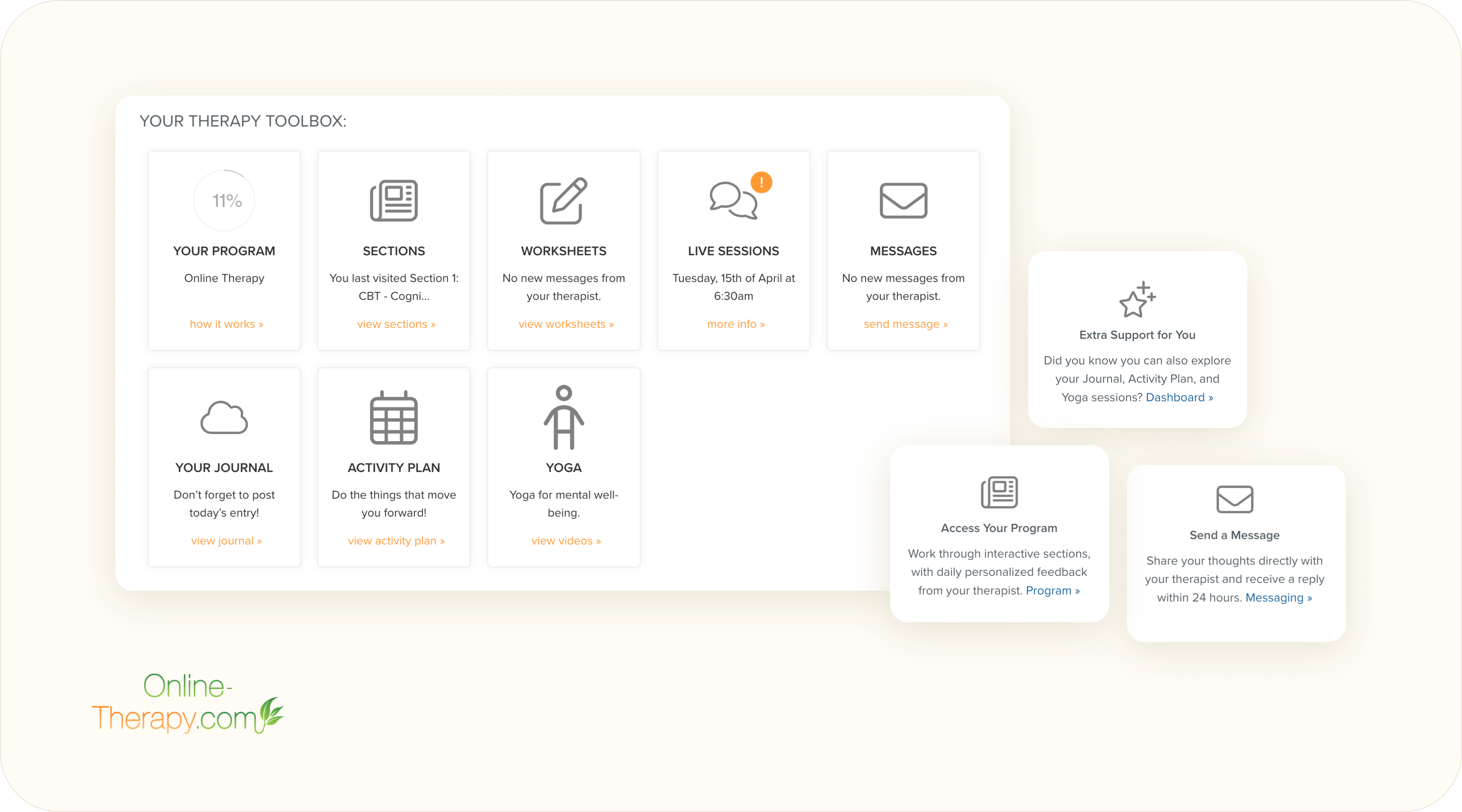
| Online-Therapy.com is most suitable for: | People looking for cognitive-behavioral therapy (CBT) without using insurance |
| Starting price: | $60-$120 per week (billed monthly) |
| Insurance accepted? | No |
| Financial aid: | Available (19% of users) |
| Therapy types: | Individual, couples |
| Session formats: | Video, audio, and text messaging |
| Time to first session with therapist: | 1-3 days |
| Psychiatry services: | No |
We surveyed 100 Online-Therapy.com users across the United States and had one of our in-house staff test Online-Therapy.com. In our survey, users described the platform as reliable, private, effective, flexible, and user-friendly. Both the users and our tester appreciated the quality of therapy and the tools included on the platform, such as worksheets.
“Online-Therapy.com helped me go from stuck to thriving.”
Survey respondent
“My confidence skyrocketed—I felt more in control of my emotions.”
Survey respondent
Overall satisfaction:
Value for cost:
Empathy rating:
Privacy and security rating:
Platform navigation rating:
“I enjoyed my experience with Online-Therapy.com. Worksheets, tools, and yoga were helpful.”
Chris Saranchock, Director of Operations & Multimedia
“I may go back to her as my therapist, and I would have gone back to my BetterHelp therapist at the time as well, so the quality of the therapy was excellent on both platforms.”
Chris Saranchock, Director of Operations & Multimedia
Online-Therapy.com’s sign-up takes under 20 minutes for most people (78 percent), but 34 percent wanted more information on therapist qualifications upfront. Here’s what happens:
Complete a questionnaire about your mental health needs and preferences.
Get matched (typically within 1–3 days).
Choose communication format: video, phone, or messaging.
Start your first session, within 3 days of sign-up for 65 percent of users.
Tested by: Chris Saranchock, Director of Operations & Multimedia
Available in all 50 states as well as the UK, Ireland, Australia, and Canada, Online-Therapy.com specializes in cognitive behavioral therapy (CBT), one of the most widely used and tested forms of therapy. CBT focuses on the connection between your thoughts, emotions, and behavior. By identifying and reframing negative thoughts, CBT can help you change how you’re feeling, stop unhelpful behaviors, and develop new, more productive ways of dealing with challenges. CBT can be effective in dealing with issues such as depression, anxiety, trauma, substance abuse, eating disorders, grief and loss, and the stresses of daily life. All the therapists on this platform are experienced in CBT techniques.
Both our staff member who tested the platform and our May 2025 survey respondents appreciated the quality of Online-Therapy.com’s therapists, as well as the “therapy toolbox,” which offers extra support through worksheets, learning modules, and activity plans, among other features. As with 63 percent of our survey respondents, our tester’s therapy sessions were a mix of a structured goals and exercises and more casual, supportive conversation. He found his first therapist to be open and empathetic, and also felt she clearly explained how the CBT process works.
The first session lasted for the full 45 minutes allocated, and was completed without any technical glitches. By the end of the session, our tester felt the therapist was fully invested in working with him. She developed a plan with goals and targets, and even offered to meet his spouse in order to understand him better. As our staff member noted, being able to meet other people in the household for just part of a session is something that’s much more easily done with online rather than in-person therapy.
At the end of all of his therapy sessions, our tester was assigned “homework,” a key aspect of CBT. These assignments are extensions of the therapy sessions, designed to help you incorporate the strategies discussed into your daily life. The first therapist directed our user to some of the resources included on the platform, as well as some of her own via the platform’s messaging system. These in-app features included worksheets for tracking moods, problems, and behavior, journaling that you can choose to share with your therapist, an activity tracker to monitor your progress, video lessons, and guided yoga. An arm injury prevented our staff tester from trying the yoga lessons, but he found the other features to be helpful.
Our Online-Therapy.com staff tester has also used BetterHelp, and in a match up between the two, he felt that the supporting content was marginally superior on BetterHelp, thanks to their live classes and group therapy sessions. But when it came to the therapist matching process, he gave the edge to Online-Therapy.com. The two platforms are comparable in many respects. Like BetterHelp, Online-Therapy.com doesn’t accept insurance, although you may be able to get reimbursed by your insurance provider. Our staff tester selected a standard monthly subscription (one live session and unlimited texting each week) with a list price of $360—the same list price as BetterHelp. As with BetterHelp, he was able to use HelpGuide’s discount code to get a 20 percent discount off the first month of therapy. 19 percent of our survey respondents also managed to secure a discount or financial aid to reduce the cost.
The process to switch therapists is equally straightforward on this platform. After completing three sessions with his first therapist, our tester would have been happy continuing with her (84 percent of our survey respondents were also happy with their first Online-Therapy.com therapist). For the purposes of testing, though, he switched, a process that required just a few clicks. This time, he was offered a list of therapists to choose from.
Cancelling the account was also a simple process. The platform allows you to choose when they should scrub your information—in case you plan to continue therapy at a future date. However, the platform is not certified by any third-party organization that evaluates data security, such as HITRUST.
Overall, our member of staff enjoyed his experience using Online-Therapy.com and, like the majority of our survey respondents (84 percent), he’d be very likely to recommend the platform to friends or family.
Our total score
Based on expert testing and real user feedback
Online-Therapy.com has high quality therapists specializing in CBT, excellent navigation and user experience ratings, and some useful extra features. However, it lacks the live group sessions offered by BetterHelp. 58 percent of the users we surveyed found the right therapist for them with their first match, as did our tester. Financial limitations were cited as the most common reason for stopping therapy on Online-Therapy.com, so not accepting insurance may count against the platform for some users.
Bottom line:
Similar pricing structure and approval ratings as BetterHelp, tailored to those looking for cognitive behavioral therapy (CBT) without using insurance.
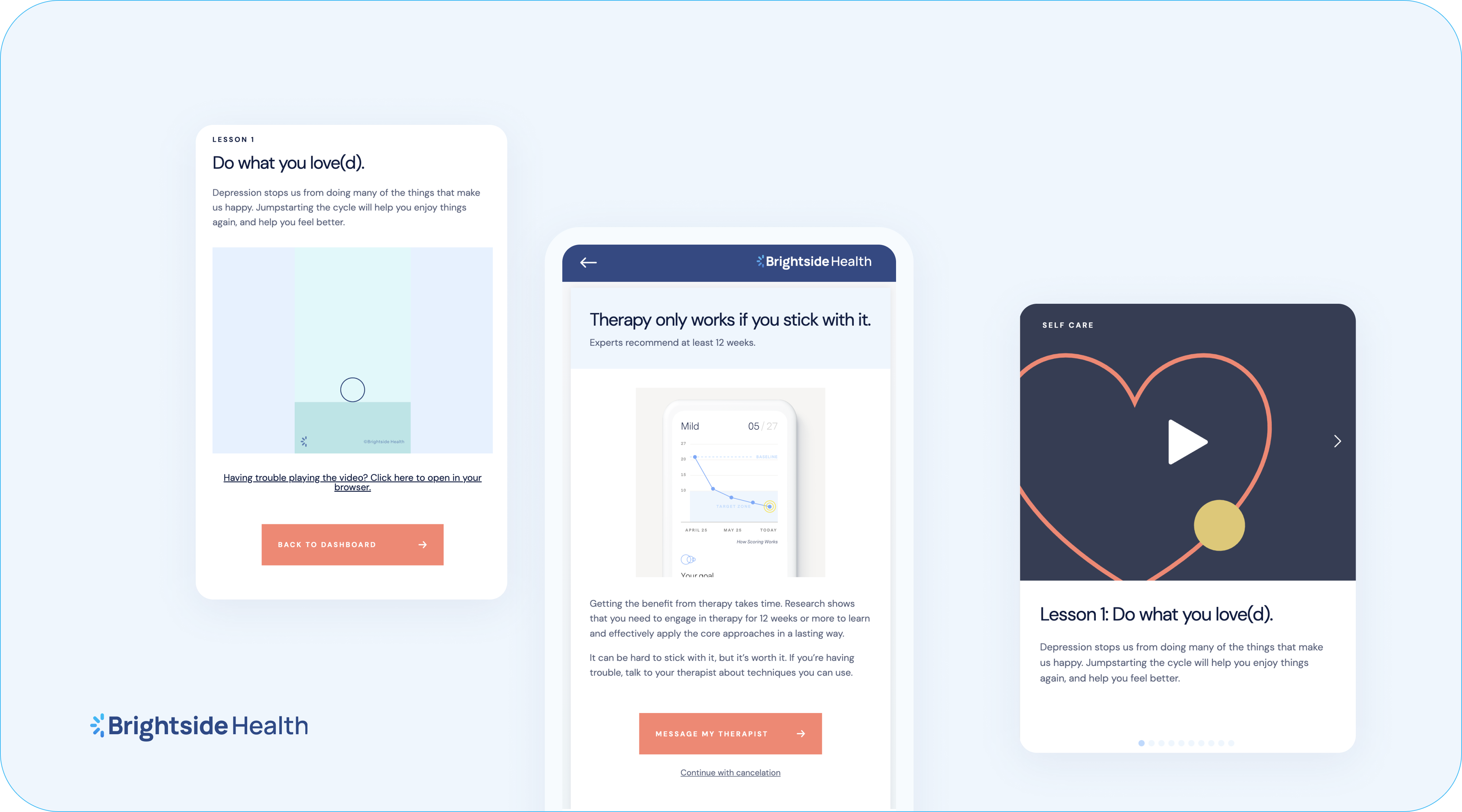
| Brightside Health is most suitable for: | People wanting to use insurance for depression or anxiety treatment |
| Starting price: | $75 per week (billed monthly at $299) |
| Insurance accepted? | Yes |
| Financial aid: | Available (24 percent received) |
| Therapy types: | Individual, teen |
| Session formats: | Video with unlimited messaging between sessions |
| Time to first session with therapist: | 1-2 days |
| Psychiatry services: | Yes |
We surveyed 100 Brightside users across the United States and had one of our in-house staff test the platform. In our survey results we found that the biggest strength was value for money, therapy experience, and security ratings. The length of the questionnaire was the primary source of frustration for both our tester and surveyed users, but 81 percent still completed the sign-up in under 20 minutes.
“Brightside helped me reframe my thoughts and take better care of myself.”
Survey respondent
“Brightside changed my perspective on therapy. I felt heard.”
Survey respondent
Overall satisfaction:
Value for cost:
Empathy rating:
Privacy and security rating:
Platform navigation rating:
“Very good experience, the platform was easy to navigate and the therapists were knowledgeable and goal driven.”
Joseph Collerain, Production Coordinator
“Besides some camera glitches with my second therapist, I noticed no problems with the site.”
Joseph Collerain, Production Coordinator
Brightside’s sign-up takes under 20 minutes for most people (81 percent), but nearly 43 percent complained about the length and lack of clarity of questions in the questionnaires, and the lack of pricing transparency. Here’s what happens:
Complete questionnaires about your mental health needs and preferences.
See list of appointment times for matching providers.
Choose an appointment then view provider bio.
Start your first session, often within 1-3 days of sign-up (68 percent).
Tested by: Joseph Collerain, Production Coordinator
Brightside Health specializes in the treatment of depression and anxiety disorders (including panic attacks and social anxiety), along with related conditions, such as bipolar disorder, obsessive-compulsive disorder (OCD), premenstrual dysphoric disorder (PMDD), and insomnia. The platform is available in all 50 states and Washington D.C., but is not currently available in any countries outside the U.S.
Brightside accepts insurance from major carriers, although—unlike Talkspace—you’ll need to create an account before you can see if you’re covered and what your copay will be. If you elect to pay out of pocket, Brightside charges a monthly subscription fee of $299 that includes weekly, 45-minute video therapy sessions and unlimited messaging with your therapist.
Our staff member who tested the platform found that the assessment during the sign-up process was thorough to say the least. Questions covered identity, relationships, home life, health history, employment status, along with a mental health evaluation. Our tester noted that he answered a total of 93 questions. While such an in-depth evaluation can help in matching you with a provider with the right expertise, if you’re already feeling restless and anxious, or depression has drained your energy and focus, this could feel overwhelming. About a quarter of our May 2025 survey respondents felt that onboarding could be improved by reducing the number of questions or providing the option to skip or revisit certain questions. That said, our staff member and 81 percent of our survey respondents completed the sign-up process in less than 20 minutes.
What our staff tester found far more frustrating was the process of selecting a therapist. He was offered a list of available appointments rather than available therapists. By clicking on an appointment time, he could then see the therapist’s name and their type of license. But he was unable to read anything more about them until he booked the appointment. Instead, he was forced to copy the therapist’s name and run a search on Google to find their bio and decide if they’d be a suitable match. We appreciate that many people want to find help as quickly as possible, but the most important factor in successful therapy is finding a therapist who’s a good fit for you.
Once matched, though, our staff member described his therapy sessions as a “great experience.” Both therapists he tried were caring and kind, went out of their way to hold the same time slot for him each week, and really seemed to care about the issues he talked about. He did experience some technical hiccups with the second therapist when her video froze very briefly multiple times throughout the session. Fortunately, this didn’t interfere with his session, as the audio wasn’t interrupted so he was still able to follow the conversation. The therapist noted that this has happened a few times but is an issue with her equipment rather than with the platform.
Both his therapists on Brightside assigned our tester homework assignments, ranging from completing a daily journal to watching Brightside’s informational videos. He found the journaling exercises more helpful than the video content. Both therapists were extremely responsive to messages sent between sessions, replying to his queries within a few hours.
When it comes to privacy, Brightside is certified for information security by HITRUST. The platform also allows you to request restrictions on the use and disclosure of your personal information, although this isn’t an easy process. Directions are buried in the notice of privacy practices and simply tell you to contact Brightside’s Member Support team, making you hunt for how to do that. That said, once they got through the process, our staff tester and survey respondents felt confident that Brightside would protect their personal information.
In one of our surveys, we asked Brightside users why they chose the platform for online therapy. The most common response was that Brightside was recommended to them by friends, family members, colleagues, or medical professionals. Having used the platform, 82 percent of respondents were likely or very likely to recommend Brightside to people they cared about. We think a lot of this high satisfaction can be attributed to the platform’s ease of use and the quality of the therapists. Our staff member summed it up by saying: “The platform was easy to navigate and the therapists were knowledgeable and goal driven.”
Our total score
Based on expert testing and real user feedback
Brightside is focused on treatment for anxiety, depression, and related conditions. The platform accepts insurance and the blend of structured and conversational therapeutic approaches is considered effective by the majority of users. The sign-up and therapist selection process, though, can be frustrating with no provider bios accessible to review.
Bottom line:
It’s a focused solution if you’re suffering from anxiety or depression, especially if you have insurance.
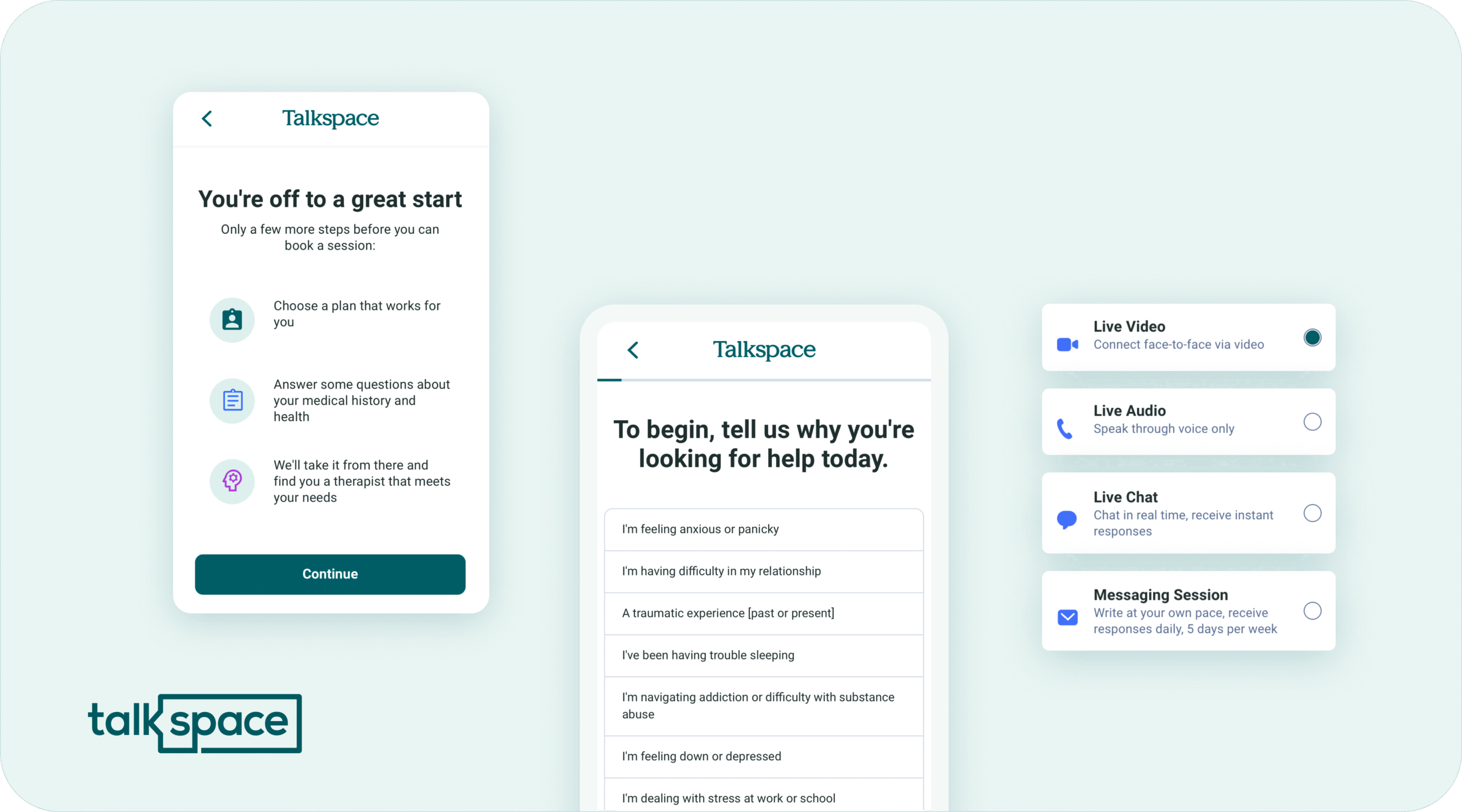
| Talkspace is most suitable for: | People looking for fast insurance approval and therapist matching |
| Starting price: | $69 – $109 per week (billed monthly) without insurance; average copay with insurance $15-30 |
| Insurance accepted? | Yes |
| Financial aid: | No |
| Therapy types: | Individual, teen, couples |
| Session formats: | Video, audio, and text messaging |
| Time to first session with therapist: | 1-3 days |
| Psychiatry services: | Yes |
We surveyed 100 Talkspace users across the United States and had one of our in-house staff test Talkspace. In our survey results we found that the biggest strengths were insurance coverage and satisfaction with the quality of therapy. Users described the platform as professional, convenient, effective, and life-improving.
“Talkspace made me a better person. I applied what I learned and saw real improvement.”
Survey respondent
“I loved it, but I stopped when I couldn’t afford it anymore.”
Survey respondent
Overall satisfaction:
Value for cost:
Empathy rating:
Privacy and security rating:
Platform navigation rating:
“I could verify if therapy would be covered by insurance before having to create an account, which I really appreciated. And instantly told me what my copay would be ($15).”
Lawrence Robinson, Managing Editor
“Therapist seemed very understanding and empathetic, with a good sense of humor. Provided some interesting insights I hadn’t considered before.”
Lawrence Robinson, Managing Editor
Talkspace’s sign-up takes 10 to 20 minutes for most people (80 percent), but 33 percent were frustrated by the length of the questionnaires. Here’s what happens:
Complete questionnaires about your mental health needs and preferences.
Get matched (usually within 1–2 days).
Choose communication format: video, phone, or messaging
Start your first session, 65 percent within 3 days of sign-up.
Tested by: Lawrence Robinson, Managing Editor
While many people start to feel better after just a few online therapy sessions, achieving long-term, positive changes can often require 12 to 20 sessions or more, depending on the nature and severity of your symptoms. If you’re paying out of pocket, the cost of therapy can start to mount up, but using insurance to pay for your online therapy can help to make those costs more manageable.
Talkspace is an online therapy platform that accepts insurance from major providers such as Aetna, Anthem, Cigna, Optum, Regence, TRICARE, and Blue Cross Blue Shield. Depending on your plan, you could pay as little as a $15 copay per online therapy session (25 percent of our survey respondents had a copay of $0). Talkspace allows you to check your insurance coverage without having to first create an account. The process takes just moments and, if covered, the site clearly displays what your copay per session will be. You can then decide whether to begin the sign-up process.
The majority of our May 2025 survey respondents were either still using Talkspace or had used the platform for at least four months. 87 percent said they were likely to recommend the platform to a friend, and only two percent reported any dissatisfaction with their therapist. These results reflect well on the quality of care offered, something that was confirmed by our hands-on testing. Our staff member felt that the first therapist he was matched with was an excellent fit and would have been comfortable continuing care with her after the testing period was over.
His first session lasted for longer than the allotted hour and the therapist went beyond the usual intake questions and setting of goals for treatment. She delved deeply into our tester’s background and provided some interesting insights and helpful CBT techniques. These were all delivered with an empathetic, nonjudgmental attitude, and a welcome sprinkling of humor. The following sessions continued in a similar vein, proving helpful and productive.
While 80 percent of our survey respondents completed the sign-up process in less than 20 minutes, one of the chief frustrations reported about Talkspace was the length of the intake questionnaire. Our staff tester felt differently, describing the questionnaire as merely “sufficient.” Anything shorter would likely result in less accurate therapist matching.
If you aren’t happy with your therapist match, or want to switch therapists for any other reason, we found the process to be quick and simple. You can keep the same preferences as before, or revise any—opting for a different gender of therapist, for example, or one with experience treating a different condition. The platform then gives you a list of therapists to choose from.
On the Talkspace app, users can access mental health exercises and tools, as well as free live workshops conducted by licensed therapists. These workshops take place over Zoom and cover relationships, parenting, and individual issues such as depression, anxiety, and work stress. Our tester found the exercises, assessment, and tracking tools to be basic, but felt they may provide some benefit to first-time therapy users. He was surprised that neither of his providers made use of any of the tools, nor suggested any of the workshops. If you conduct your therapy sessions via the Talkspace website rather than the app, you’re likely to overlook a lot of these extra features.
TalkSpace allows you to request restrictions on the use and disclosure of your personal information, although, like Brightside, it isn’t an easy process. Still, while it took some form-filling to achieve, our staff tester was able to limit disclosure of his personal health information (some information still went to his insurance company for billing purposes). At the end of testing, he was also able to ensure that Talkspace deleted all data and personal information from their records. When you’re feeling overwhelmed by a mental health problem, the steps needed to protect your information may feel challenging—and we question why Talkspace can’t make the process easier. But ultimately, our tester felt that his personal information was probably better protected on Talkspace than some other platforms he tested.
Our total score
Based on expert testing and real user feedback
Talkspace has a wide selection of therapists, accepts insurance plans from major providers, and offers a useful app with extra features and workshops to support therapy. Financial aid is not available and the most common reasons for cancelling Talkspace were financial, such as insurance running out.
Bottom line:
It’s a good choice if you have insurance, and take the steps to ensure your privacy is protected.
| Platform | BetterHelp | Online-Therapy .com | Brightside | Talkspace |
|---|---|---|---|---|
| Known for | Large therapist selection | Specializing in CBT | Focus on anxiety and depression | Fast and easy insurance check |
| Price | $65+ | $60+ | $75+ | $69+ |
| Insurance acceptance | No | No | Yes | Yes |
| Session types | Video, Phone, Chat | Video, Phone, Chat | Video, Messaging | Video, Phone, Messaging |
| Satisfaction score |
In addition to our picks for the four best online therapy services detailed above, we tested plenty of other platforms that we felt unable to endorse. There were also a couple of platforms that fell somewhere in between: There was much to recommend about them, but they just fell short in one or two key aspects.
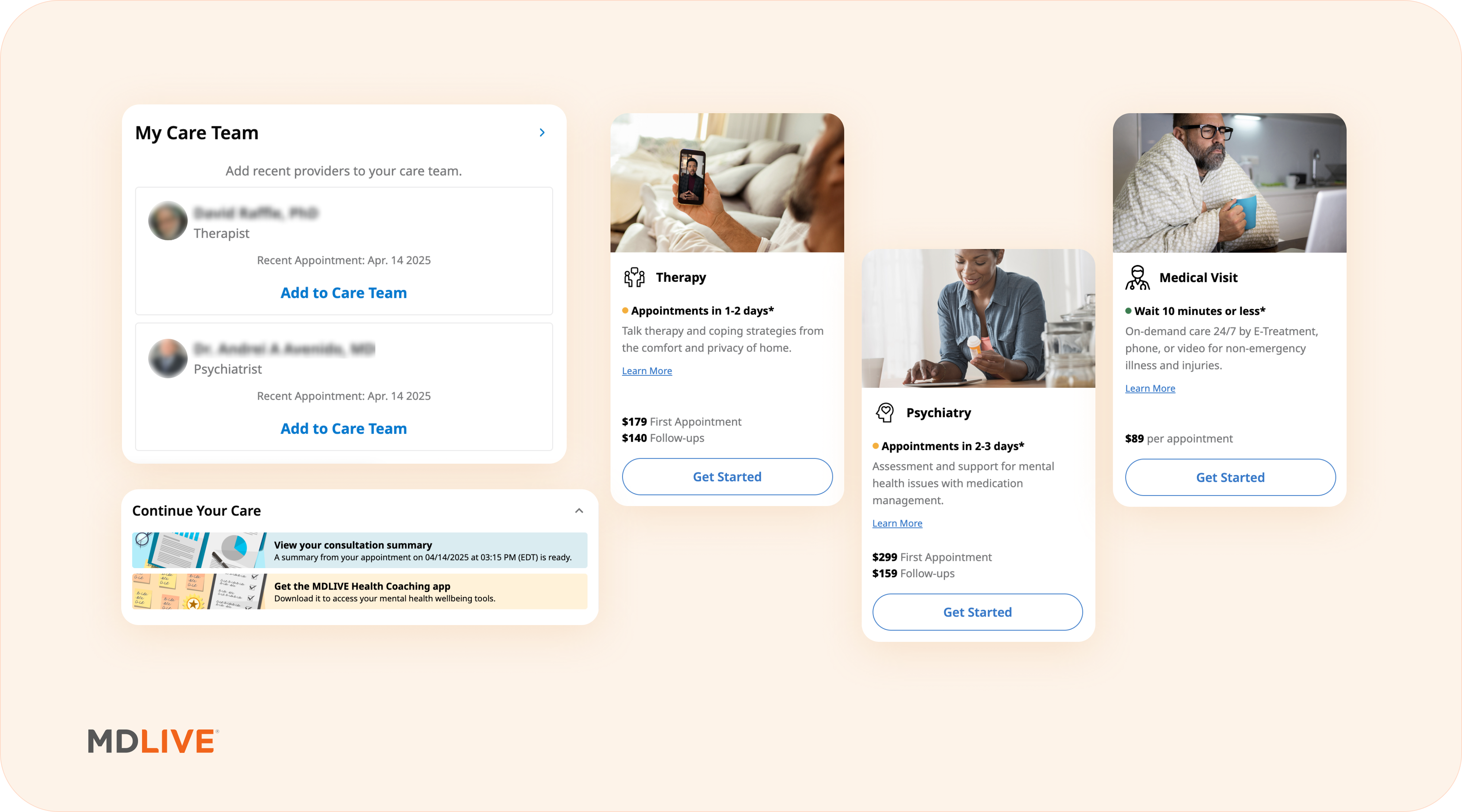
MD Live is a telehealth platform that offers medical care as well as mental health care (both therapy and psychiatry) across the United States. The platform accepts major insurance plans such as Cigna, Humana, Blue Cross/Blue Shield, and Aetna. Instead of matching you with a therapist, it allows you to choose from a list of providers fitting your preferences.
Our staff member who tested the platform was extremely impressed with the quality of the therapists he found on MD Live. “I honestly felt like I was being heard and understood in therapy for the first time,” our tester said about his first pick. He felt he could continue with his therapist after testing finished. When we surveyed real MD Live users in May 2025, they largely felt the same. 87 percent of users rated their therapist 4/5 or 5/5 for their overall quality. We were also impressed by MD Live’s privacy and security protocols. The platform is accredited by the National Committee for Quality Assurance (NCQA) and certified by HITRUST for security. In addition to the quality of providers and trustworthiness, we also appreciated MD Live’s quick signup and the short wait for appointment times.
While MD Live came very close to being a top pick, we ultimately didn’t include it because of cost. Without insurance, MD Live can get expensive. For self-pay, an initial therapy session costs $179, while subsequent sessions cost $140 each. 30 percent of our survey respondents also experienced some technical issues on the platform, and our staff member missed being able to message his therapist between sessions—a feature MD Live doesn’t offer.
Still, there is much to recommend about MD Live, not least the quality of therapists available on the platform. If you have insurance and the platform accepts your plan, MD Live is definitely one to consider. In fact, it is one of our top-rated picks for Best Online Therapy Platforms that Accept Insurance.
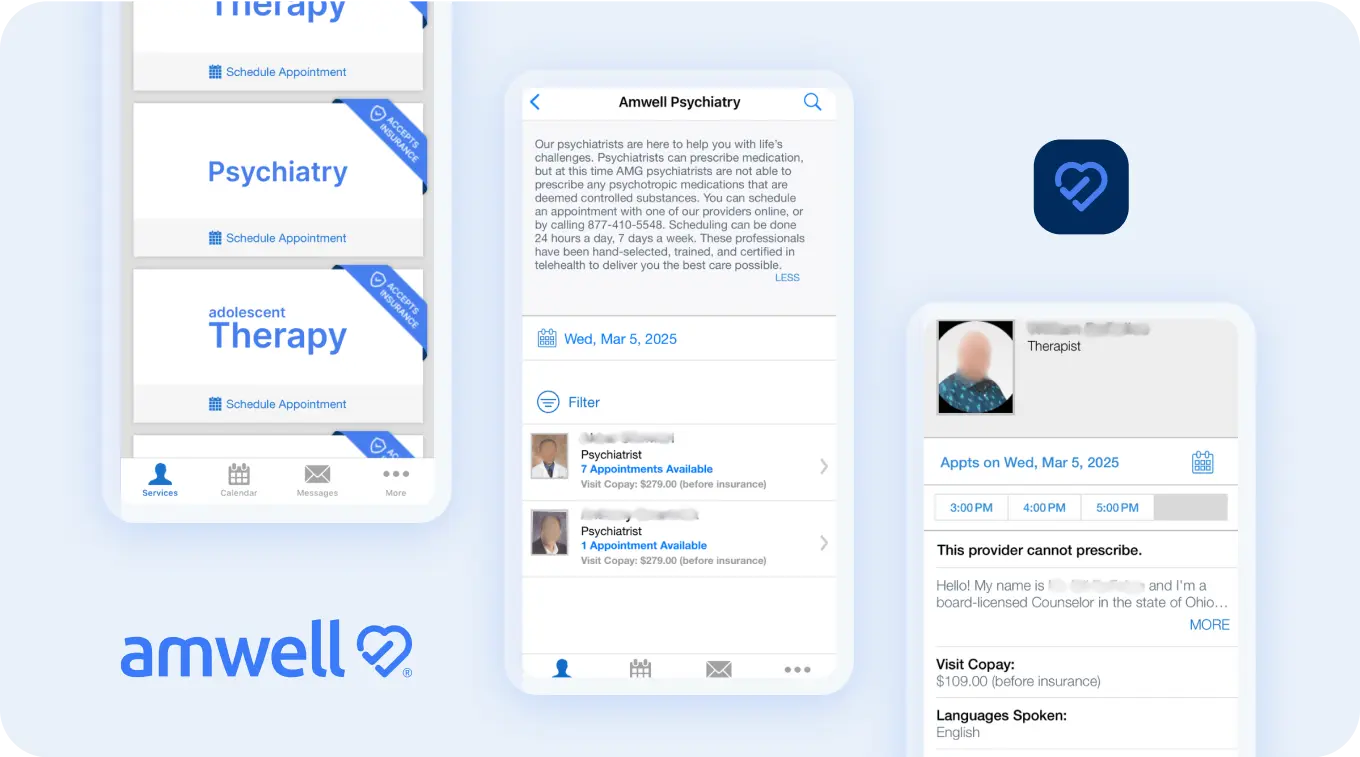
Amwell is a telehealth platform that allows you to consult with different types of medical providers, including online therapists and online psychiatrists. Our staff tester liked the simplicity of the platform, the quality of the therapists, the clarity of pricing, and the crisis and privacy protocols.
Our staff member likened Amwell to a modified directory. You have to sign up for an account before you can browse any providers or see if the service accepts your insurance. Each provider charges their own fees—but these are clearly displayed on their profiles and most were $109 per session if you’re paying out-of-pocket. There’s no onboarding or screening until you’ve booked an appointment with a therapist.
You can filter providers by gender, language, and specialty (therapist or psychologist). However, our staff member found that even when he removed all filters the list of available therapists in California amounted to just five. In less populated states, we worry that it may be difficult to find any available therapists, let alone have a choice of gender, language, or specialty. But despite the limited selection, our staff member still found an excellent therapist. Similarly, 86 percent of our May 2025 survey respondents also reported high satisfaction with their therapist, with most finding a good match with the first or second therapist they tried.
Our staff tester also appreciated Amwell’s follow up features. After each session, the platform messaged him a “visit summary” with the therapist’s notes, including reminders of any strategies discussed or homework tasks assigned. This freed him up to concentrate fully on his therapy sessions, rather than worrying about taking notes of his own. We also think these visit summaries are very useful for making sure that you and your therapist are on the same page and there’s no miscommunication. When it comes to privacy, Amwell is HITRUST-certified for information security. It is also accredited by the NCQA and URAC, independent nonprofits that set and review compliance with national standards for healthcare quality and safety. If it builds a larger selection of therapists, we think Amwell could make our Best Of list in the future.
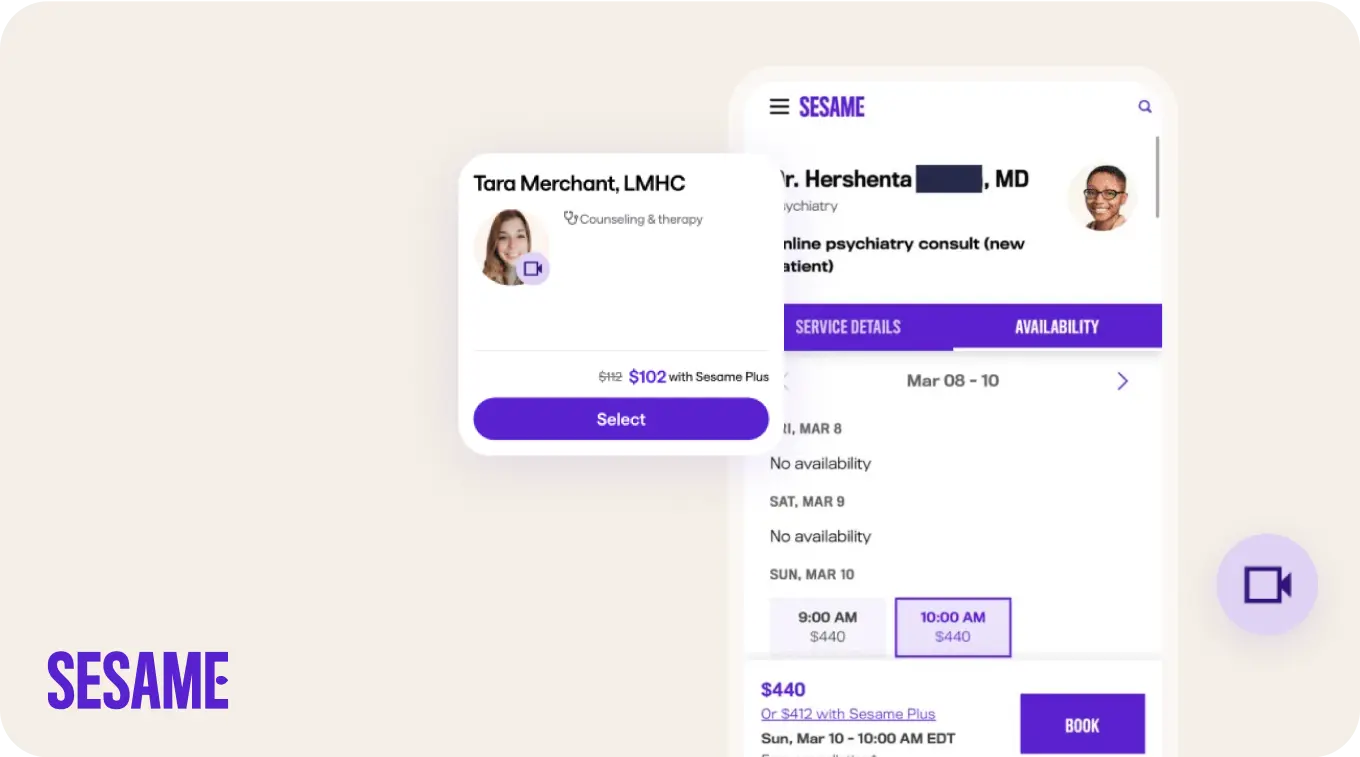
Sesame bills itself as a health care “marketplace” where you can find discounted telehealth appointments with medical providers, including online therapists and psychiatrists. If you don’t have insurance or you have insurance with a high deductible, Sesame could be a good option for finding affordable care.
Our staff member testing the platform felt it was great value at just over $100 per session. Rather than complete an assessment questionnaire, she skipped straight to browsing providers, their upcoming availability, and the cost of an appointment.
You don’t need a subscription to use Sesame. However, joining the Sesame Plus membership program for $10.99 per month entitles you to a $10 discount for each visit. This may be something to consider if you intend to seek regular therapy through the platform, or use it for other medical services as well, such as primary care consultations.
Like Amwell, our tester noted a limited selection of therapists on Sesame. There’s also no way to filter by specialty. Instead you have to click through each one and read their bio. However, she was able to find some same- and next-day appointments available. Most importantly, our tester was impressed by the quality of therapists, rating the two she tried very highly. Our survey respondents felt similarly, 93 percent considering that Sesame Care helped them to make at least moderate progress toward their personal goals in therapy.
Some of the other reputable online therapy platforms that HelpGuide staff tested provided mixed results. Depending on your specific circumstances, some may still be worth considering. However, based on our research and analysis, user surveys, and staff testing, we felt the platforms above ranked higher overall.
Thriveworks offers individual, couples, and family therapy in every state of the U.S. except Vermont. In our Best Online Therapy Platforms that Take Insurance recommendations, Thriveworks just missed out as one of our top recommendations. It accepts many insurance plans, such as Blue Cross, Anthem, Optum, United, Aetna, Cigna, and Humana, as well as Medicare. If the platform is in-network with your insurance provider, a typical co-pay is $0 to $55, which our staff tester thought was good value for the quality of therapy he received. He also appreciated being able to preview providers on the platform before having to create an account.
However, if Thriveworks isn’t in-network with your insurance or you’re paying out-of-pocket, it can be expensive. An initial therapy session costs $200 to $240 depending on where you live; subsequent sessions cost $160 to $195. It was no surprise that our May 2025 survey of Thriveworks users revealed that 78 percent used insurance, 30 percent with no co-pay.
During his testing, our staff member also found that the number of therapists on the platform accepting new clients was very limited. This was reflected in our survey, where 35 percent of Thriveworks users had to wait at least four to six days for an initial appointment. Our tester also experienced some frustrating technical problems when trying to connect with his therapist on Thriveworks. “Being locked out was super confusing and a little stressful,” he noted. 32 percent of our survey respondents also experienced technical issues that disrupted their experience, on multiple occasions for nearly one in four users (24 percent).
LiveHealth Online is a telehealth service that offers video visits in all 50 states with medical and mental health care providers, including therapists. LiveHealth is a covered benefit for most Anthem insurance plans, although you have to create an account to confirm that your specific plan is covered. It is also available through some universities and employers, or you can pay out of pocket. Online therapy visits on LiveHealth cost $100 with a psychologist or $85 with another type of therapist.
While 62 percent of our survey respondents thought that LiveHealth Online compared favorably with in-person therapy, our staff tester was less convinced. “Overall my experience was not great,” he noted. “Scheduling appointments was difficult and my therapists were not particularly helpful.” When he signed up to the platform, he was offered only one therapist and one time slot. After his first session, he went to schedule a follow-up appointment to find the only available time slot was three weeks away. When he switched therapists later on in his testing, he was again offered only one therapist with very limited time slots available.
More positively, our staff tester thought the website was easy to navigate and customer support was helpful. Our survey respondents agreed. 84 percent rated it easy or very easy to navigate and 93 percent of those who contacted LiveHealth’s customer service had their issues resolved satisfactorily. Other platforms ranked higher for us, but LiveHealth may still be an option to consider for those with Anthem health insurance.
Cerebral offers mental health care across all 50 states, including individual and couples therapy. The subscription-based platform accepts a number of major insurance plans or you can pay out of pocket. The cost of Cerebral’s monthly subscription for individual therapy is $295, which includes weekly 45-minute video or phone sessions with your therapist, plus messaging between sessions. Paying upfront for three months can lower the cost by $30 per month, or you can combine therapy with a medication plan for $365 per month.
Cerebral has faced some controversy in the past for overprescribing controlled medications and sharing the personal information of users with other companies. The platform has resolved both issues with The Federal Trade Commission (FTC).
89 percent of our May 2025 survey of Cerebral users rated their experience with their therapist on the site as good or very good. Our staff tester agreed, but felt that finding a quality provider wasn’t a straightforward process. Initially, all his matches were “associates” working under the supervision of a fully-qualified therapist—they’d completed the education part of their license and were gaining clinical experience. Now, everyone has to start somewhere, so offering therapy from someone not-yet-fully-licensed at a discounted rate could be beneficial for users looking to save money. But the cost was the same for an associate as a fully-licensed therapist. Only when our staff member complained to customer service was he offered fully-licensed therapists to choose from.
Another concern arose when our staff member messaged his provider on Cerebral. He received an automated response informing him that his messages were also being viewed by other undisclosed staff at Cerebral, something he was unhappy about. While 83 percent of survey respondents were likely to recommend Cerebral to others, our testing and analysis suggested that other platforms are worth considering ahead of this platform.
Doctor on Demand is a telehealth platform that offers both medical and mental health care, including therapy. It accepts many major health insurance plans, but if you’re paying out of pocket, therapy can get expensive: $134 for a 25-minute therapy session or $184 for a 50-minute session. Of the Doctor on Demand users we surveyed in May 2025, only 18 percent elected to pay for therapy without using insurance.
Aside from the high self-pay cost, users also reported some technical issues with Doctor on Demand. 32 percent of our survey respondents experienced technical problems such as difficulty logging in for an appointment or poor video quality during the session. Our staff tester didn’t experience issues of that sort, but was frustrated by some of Doctor in Demand’s overall practices. While she’d signed up to pay out-of-pocket, without her knowledge or permission the platform contacted her insurance company. This meant that her therapist could see her medical history and medications, something she was very uncomfortable about, especially as the therapist proved not to be a good fit.
Unfortunately, our staff tester was then unable to change therapists—a side-effect of the platform trying to link her insurance. She contacted customer service but was unable to resolve the issue. For her, the good aspects of the service—being able to search for a therapist by specialty, for example—were overshadowed by this negative experience. Our survey respondents fared better, however, with 57 percent very satisfied with their overall experience and 47 percent very likely to recommend Doctor on Demand to others. Whether using insurance or paying for therapy yourself, though, we found other services worthier of our recommendation.
There are many different options when it comes to online therapy platforms. Some will automatically match you with a therapist who meets your criteria, others will offer you a list of therapists to choose from. Some restrict you in how you can connect with a therapist, others offer you a choice of messaging, phone, and live video. Some platforms are very basic but easy to use, while others offer a host of extra features to supplement your therapy sessions.
When choosing an online therapy platform, you may want to consider factors such as:
Therapist selection. Ultimately, finding the right therapist for you is the most important consideration. Without the right connection between you, therapy is unlikely to be very successful. Do you want a therapist that shares your cultural background or sexual orientation, for example, or one who speaks a language other than English? Some platforms match you with a therapist based on your selection criteria, while others let you choose from a filterable list. Since it often takes some trial and error to find a good fit, it’s important that a service allows you to easily switch therapists until you find the one that’s right for you.
Affordability. Trying to find an online therapy service that fits your budget can be tough. Using a therapy service that takes your insurance often means you’re only charged for a copay, depending on your plan. If you choose a platform with a subscription, paying up-front for longer can often bring the total cost down. Some platforms offer financial assistance, while private therapists sometimes charge for their services on a sliding scale, so you pay based on your income. You can also take advantage of any coupon codes or introductory offers to help lower costs.
Privacy. In the United States, the Health Information and Portability Accountability Act (HIPAA) means that legally what you tell your therapist is private and confidential—unless you’re deemed a danger to yourself or others. However, you also want to make sure that connecting with a therapist is also done on a secure platform. Checking a service’s privacy policy will let you know the level of privacy measures and data protection they offer.
How quickly you can get started. When you’re struggling with a mental health issue, you likely want to start therapy as soon as possible. Many popular online therapy services promise to match you with a therapist within a few days and schedule your first appointment within a week or so. Of course, where you’re located, the availability of suitable therapists, and your stated preferences mean matching could be much faster—or slower.
Extra features. Some online therapy platforms offer extra features in addition to therapy sessions. These may include group therapy sessions, webinars, video tutorials, relaxation exercises, and tools to track your progress or mood. Others enable you to message with your therapist between sessions with any questions or concerns, or offer check-ins to monitor your well-being. Consider which functions are likely to be most useful for you.
Ease of use. One drawback to online therapy can be technical issues that sometimes arise, interrupting the therapy experience. Take a moment to browse an online therapy platform or app to test its functionality and make sure it’s easy for you to use.
Crisis response. Some platforms ensure that your therapist knows the exact address where you’re having your online therapy session, so they can summon help if you’re in crisis and the connection’s lost. Others simply include a link on the platform that connects you to a crisis helpline. When relaying crisis protocols, there can often be inconsistencies from therapist to therapist on the same platform. When considering an online therapy platform, it can be reassuring to check how they handle crisis situations.
Finding the right therapist for you often takes some time and trial and error. You’re looking for someone you can trust, someone you feel comfortable opening up to and talking honestly about your innermost thoughts and feelings. You also want to feel safe, heard, and understood by your therapist.
You may be fortunate and find the right connection with the first therapist you try. Or you may have to shop around and change therapists a few times to find one that’s a good fit. When choosing an online therapist, you may want to consider:
Licensing. Online platforms should be vetting their therapists, but it’s still a good idea to make sure the therapist holds a current license and is in good standing with your state’s regulatory board. You can do this by searching on Google for your state, therapist type, and clinical license (for example: “Florida LMFT license verification,” or “California psychologist license verification”). When looking up your therapist’s license, you will also be able to see if any complaints have been made against the therapist.
Experience and specialty. Look for a therapist who is experienced in treating the issues or challenges that you’re dealing with. Therapists often have areas they specialize in, such as anxiety, ADHD, or relationship counseling. When they’ve experienced dealing with specific problems over and over, a therapist may be able to offer you more insight and a broader range of coping tips.
How well you gel. When you look at their online profile, a therapist may seem like the perfect fit, but you can never be certain until you meet them. If the connection doesn’t feel right, you don’t feel comfortable opening up to them, or you don’t feel they understand or care about your problems, it’s fine to search again. One of the advantages of online therapy is that it’s often easier to switch therapists. On many platforms, it merely takes a few clicks.
We asked over 1,300 users of online therapy platforms about their experiences and how online therapy compared to traditional in-person therapy. Here’s what they told us:
“My therapist online was more consistent and engaged than the one I saw in person for two years. I felt more comfortable opening up from home.”
Survey respondent
Among users who preferred in-person therapy, common reasons included:
| Online Therapy | In-Person Therapy | |
|---|---|---|
| Accessibility | 24/7 access | Limited hours |
| Average cost | Out of pocket: $60-200+ Insurance copay: $0-50 depending on plan, deductible, etc. | Out of pocket: $100-200+ Insurance copay: $0-50 depending on plan, deductible, etc. |
| Effectiveness | 64% rated it as effective as in-person therapy, according to our survey results | 15% rated it more effective than online therapy |
| Top benefit | Convenience and flexibility | Greater sense of personal connection |
| Largest drawback | Can feel detached or less personal sometimes | Less convenient |
Online therapy platforms aren’t your only option for finding a therapist. If you have insurance, you can check with your insurance company to find a therapist in-network. You can also get recommendations for private practice therapists from friends or your primary care doctor.
If you don’t have insurance or are struggling to afford therapy, you may still have some options:
You can also find online services and directories that cater exclusively to certain groups. For example:

National Queer & Trans Therapists of Color Network provides mental health practitioners with a focus on the queer and trans people of color (QTPoC) community.

Therapy for Black Girls offers resources for women of color.

Therapy for Black Men offers a directory of therapists catering to Black men and boys.
We’d love to hear from you! Your feedback helps us improve and make sure you’re finding the support and information you need.
How to get the most out of your therapy and counseling

Lexapro (escitalopram) is an FDA-approved medication for long-term anxiety treatment. Learn more about how this medication works and its side effects.

Millions of readers rely on HelpGuide.org for free, evidence-based resources to understand and navigate mental health challenges. Please donate today to help us save, support, and change lives.
Donate to HelpGuide.org today